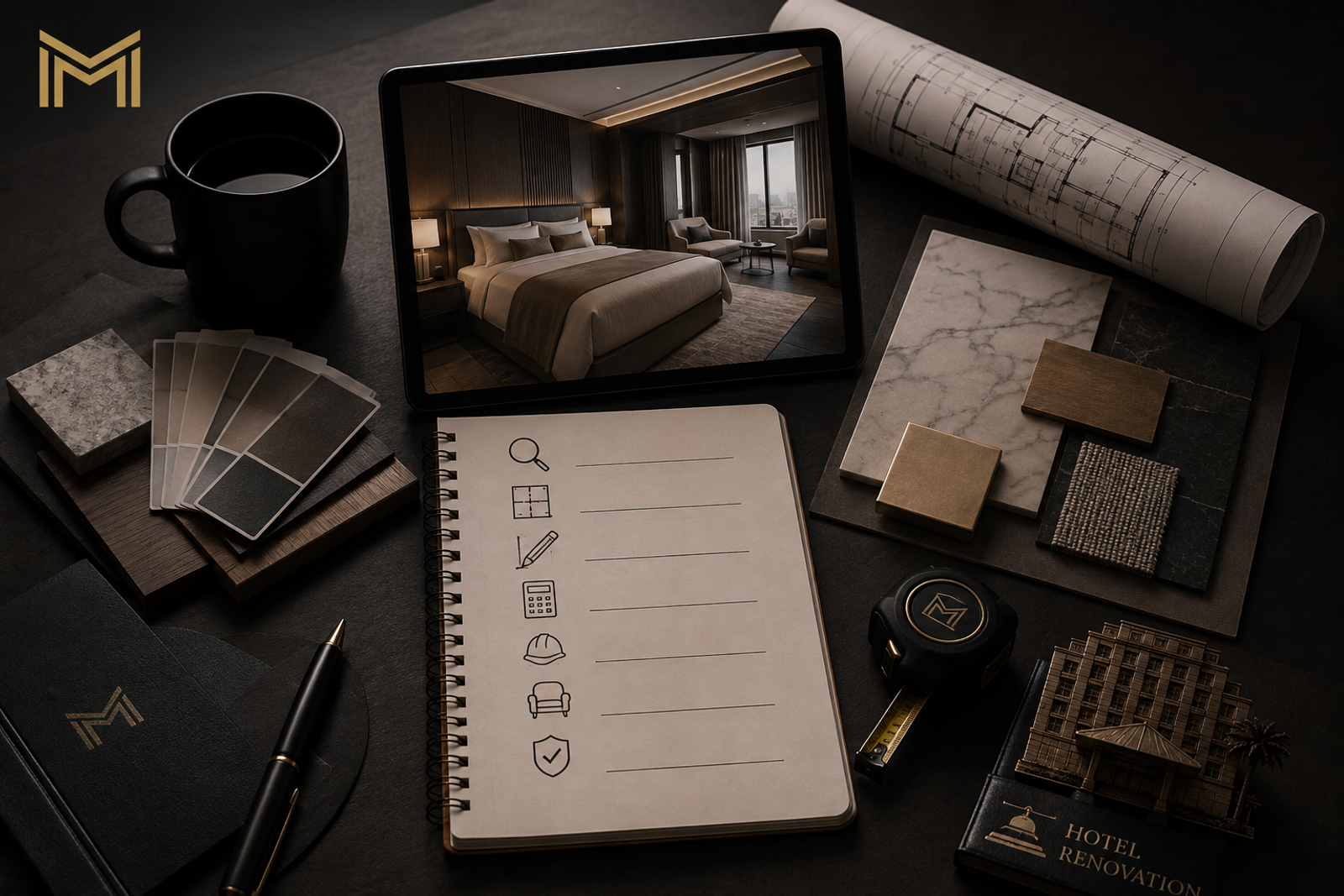
Commercial renovations are strategic investments. They sharpen competitiveness. They lift revenue potential. They elevate guest perception and long-term asset value.
But strong outcomes aren't decided during construction. They're decided before it. Clear strategy. Realistic budgets. Smart sourcing. Coordinated logistics.
Focus on these seven priorities to reduce risk and improve results.
1. Define the Commercial Objective
Every decision should serve a business goal.
Before selecting furniture, finishes, lighting, or fixtures, define what the renovation is intended to accomplish.
Are you repositioning to raise ADR? Meeting updated flag standards? Preparing the asset for sale? Responding to new competition? Elevating an outdated guest experience?
Every choice should support measurable outcomes: ADR, RevPAR, competitive positioning, investor expectations, operational performance.
A new lobby drives first impressions. Upgraded guestrooms often drive stronger returns. Aligning design with commercial goals puts capital where it creates the most value.
2. Build a Realistic Budget
Underestimating cost is the most common mistake.
A complete hospitality renovation budget should account not only for construction, but also for procurement, logistics, and installation costs.
- FF&E (Furniture, Fixtures & Equipment)
- OS&E (Operating Supplies & Equipment)
- Freight and shipping
- Customs duties and tariffs
- Storage and installation
- Professional fees
- Contingency reserves (10–15%)
Manufacturing costs, freight rates, currency shifts, and supply chain conditions all move. Planning for them early protects the budget.
3. Establish a Sourcing Strategy Early
Procurement is one of the most influential factors in the success of a hospitality renovation. Selecting the right suppliers, understanding manufacturing lead times, coordinating international logistics, and ensuring product quality all have a direct impact on cost, schedule, and guest experience.
Before sourcing begins, determine:
- What requires custom manufacturing
- What can be sourced locally
- Lead times for key materials
- Minimum order quantities
- Sustainability and compliance requirements
Custom casegoods, decorative lighting, specialty millwork, imported stone, and upholstered furniture often carry the longest lead times.
Early sourcing keeps design, production, and budget aligned. It gives procurement teams time to qualify suppliers, inspect quality, and coordinate logistics.
4. Build the Timeline Backward
Start from reopening day, then work back.
Plan forward from construction, and risk compounds. Build the schedule backward from your target reopening date instead.
- Production timelines
- Freight schedules
- Installation sequencing
- Flag and design approvals
- Schedule contingencies
Long-lead time FF&E often drives the overall project pace. A production delay can ripple through shipping, customs, installation, staffing, and reopening. Realistic buffers aren't extra caution — they're risk management.
5. Plan for Operational Continuity
Many hotels stay partially open during renovation to protect revenue. That takes careful coordination.
- Phased floor closures
- Noise management
- Temporary guest wayfinding
- Staff workflow adjustments
- Service elevator coordination
- Clear guest communication
Managed well, a renovation reinforces your commitment to the guest experience while protecting revenue and reputation.
6. Align Stakeholders Early
Procurement professionals provide critical insight during the design phase by identifying sourcing challenges, evaluating supplier capabilities, and verifying product availability before specifications are finalized.
Owners, operators, asset managers, designers, procurement teams, contractors, and flag representatives all shape the outcome.
Weak communication between these groups drives delays, redesigns, and budget overruns.
Bring procurement into design development, not after. Their expertise in sourcing feasibility, material availability, production timelines, and budget alignment surfaces risk before it becomes costly.
Early collaboration means faster decisions and smoother execution.
7. Develop a Risk Mitigation Strategy
Prepare for uncertainty. Respond faster than it.
No renovation is free of surprises. Today's hospitality projects face supply chain disruptions, fluctuating freight costs, customs delays, and extended manufacturing lead times. A proactive procurement strategy helps minimize these risks before they affect the project schedule.
- Backup suppliers
- Pre-approved material alternatives
- Freight insurance
- Storage solutions
- Milestone-based payment tracking
- Contingency procurement plans
The strongest projects aren't the ones without challenges. They're the ones ready to respond.
Successful Renovations Begin With Planning
A successful hospitality renovation starts with clear objectives, realistic budgets, early sourcing, and aligned stakeholders. The earlier procurement planning begins, the greater the control over costs, timelines, and project outcomes.
At Moksha LLC, we approach procurement as a strategic part of the renovation process. From FF&E sourcing and supplier management to logistics coordination, we work with owners, developers, designers, and operators to keep projects moving efficiently from concept to completion.
Planning a renovation? Partner with Moksha LLC to build a procurement strategy that keeps your project on time, on budget, and ready to welcome guests with confidence.
www.mokshallc.net
If you're planning a hotel renovation, repositioning, or ground-up development, reach out to start the conversation:

Moksha LLC
Excellence in Every Build
Strategic Procurement. Global Sourcing. Proven Execution.